Self-tests
PptxDiff carries its own in-browser regression suite — no separate test runner, no build step, no CI required to exercise it.
Running them
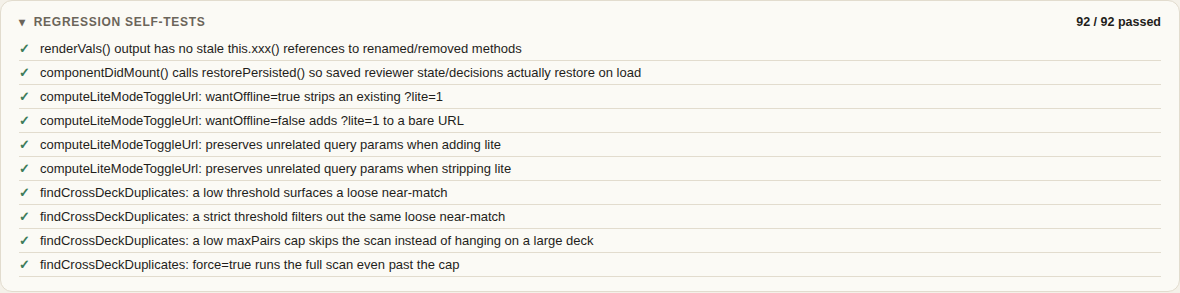
Click Run self-tests in the app. runSelfTests() is async and reports pass/fail results in a panel once it completes.
What's covered
- Word-level diff correctness
- Slide similarity scoring
- Deck alignment (add / remove / move scenarios, including the exact same-position-vs-moved tie-break case)
- Duplicate detection (same-deck and cross-deck)
- Scheme-color resolution
- Key-namespacing (the
pairKey/pairKey::diffKeyconventions used throughout decisions/comments/merge) - Diff rollups ("X of Y reviewed")
- Filename similarity (used by batch mode's filename-pairing mode)
- A real merge-export round-trip: builds a 2-slide
.pptxviabuildPptx, re-parses it with the app's own reader, and asserts slide count and text survived - Every pure decision/builder function added alongside a feature —
mergeReportPatch,buildConfluenceNewBody,interpretSlackDeliveryOutcome,buildCredsPayload,computeDecisionsToClear,buildConfirmConfig,computeLiteModeToggleUrl(the Offline Mode toggle's URL logic), and others — each with a dedicated Red/Green test
A standing regression guard
checkStaleMethodRefs() is the first self-test that runs. It walks the full rendered-template output tree and statically scans every function's source for dead this.xxx() calls — references to methods that no longer exist. This exists because a refactor once caused a full blank-page incident from exactly that kind of stale reference; the guard catches a repeat before it ships.
Why this matters for a single-file app
Because the whole application is one HTML file with no build step, there's no separate npm test to run in CI before a change ships. The self-test suite is how correctness gets checked in the same environment the app actually runs in — a real browser, against the app's own real parsing/rendering/diffing code, not a mocked unit-test harness. New features in this codebase are built pure-function-first (extract a pure decision/builder function, write a Red/Green test against it, then wire the impure DOM/network/localStorage shell around it) specifically so this pattern stays fast and reliable as the app grows.